Canned Tuna Preserved in Oil
The Florios of SicilyCanned Tuna Preserved in Oil is a preservation method and commercial project that joins Vincenzo Florio’s childhood memory to his effort to remake Sicily’s tuna trade. Faced with declining sales of salted fish, he revives an idea of tuna stored in olive oil, tests it for years, and then proposes cooking the catch and sealing it in oil for extended storage. The project is at once a practical answer to a market problem and an emblem of his refusal to accept that Palermo’s industries must remain small.
Origins in memory and market change
The idea returns to Vincenzo while he is helping Giulia open a can of tuna in brine from the Arenella fishery, which he owns in partnership with Augusto Merle. The can’s opening recalls a kitchen in Piano San Giacomo and his father preparing fish: after desalting it in hot water, his father had immersed it in oil as a means of keeping it for weeks. Vincenzo’s memory takes the form of a sudden recognition—oil and tuna—and becomes a possible answer to a present commercial difficulty.
That difficulty is a broader fall in demand. Reading a report with Carlo Giachery, Vincenzo learns that tuna sales are declining at fisheries not only in Sicily but elsewhere, and that demand for sardines and mackerel has also dropped. Salted tuna has long been the customary product, but shipping companies and sailors are wary of it because they associate it with scurvy. The old method is therefore losing customers just as the industry needs a new way to make its catch useful to them.
Experiment and the year of waiting
Vincenzo asks when the next mattanza at Arenella will take place and learns it is ten days away. He reasons that cooking meat can make it more resistant to decay and asks how it might be kept for six months, a year, or longer—long enough for an ocean voyage. He gives Giachery his proposed answer, drawing on the remembered practice of soaking fish in oil after desalting it.
The first substantial test is deliberately slow. After the May catch, cans—some tin, some glass—filled with tuna in oil are stored in Giachery’s pantry under the watch of his wife, Carolina. The containers must remain there for a year before the experiment can establish whether cooked tuna, covered with oil and sealed in a container, will keep over time and survive a sea voyage. The waiting period makes innovation depend not only on a flash of recollection but on patience and proof. Vincenzo’s determination to try something new is also linked to a desire to control the direction of his life.
From trial to production
When Vincenzo later explains his plan to the rais Saro Ernandez, he describes a process more specific than the earlier pantry experiment: the tuna will be cut and boiled, then preserved in oil in airtight barrels. Several gallons of oil are being unloaded from a Florio steamboat for the work. Vincenzo says the trials have already run for several years, using fish from Arenella and San Nicolò l’Arena with Giachery’s help, and that the project has been under development for more than three years.
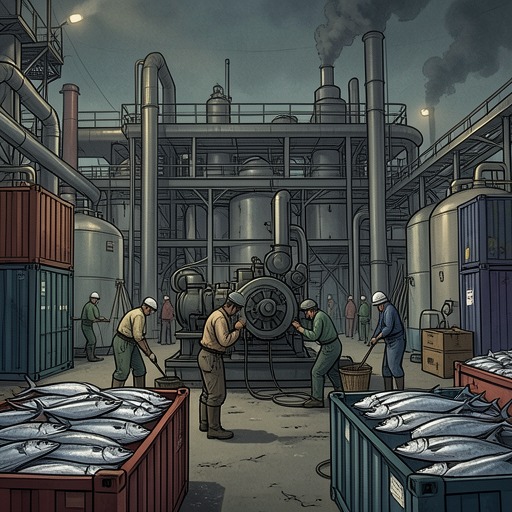
The proposal changes the intended organization of the fishery as well as the product. Vincenzo wants the marfaraggio altered to include boilers for cooking the fish and accommodation for seasonal workers. He says the work will employ families, not only fishermen. Ernandez objects that the method may fail and that local people cannot do what Vincenzo expects of them. Vincenzo answers that the Florios will begin themselves and others will learn together. He also incorporates the catch’s by-products into the scheme: tuna fat will be used for lamp oil, and the dry bones for soil.
Commercial ambition and wider significance
The project’s eventual scale is presented through Vincenzo’s confidence that the family has been canning and selling tuna in oil for years and that demand continues to grow. He expects to trade the product on a large scale and treats market results, rather than the label of visionary, as the answer to skepticism. In his view, a local operation can serve a wider trade instead of remaining confined to the small workshops he associates with Palermo.
The method thus recasts tuna from a traditionally salted catch into a cooked, oil-preserved product intended to keep for months or longer, including during sea travel. Its narrative importance rests on the sequence linking memory, market pressure, experiment, and industrial plans: a household practice becomes a testable process, then a proposed system of production and employment. The cans in Giachery’s pantry mark the interval between an idea and evidence; the later plan for boilers and seasonal family labor shows how much more Vincenzo wants the idea to change.